
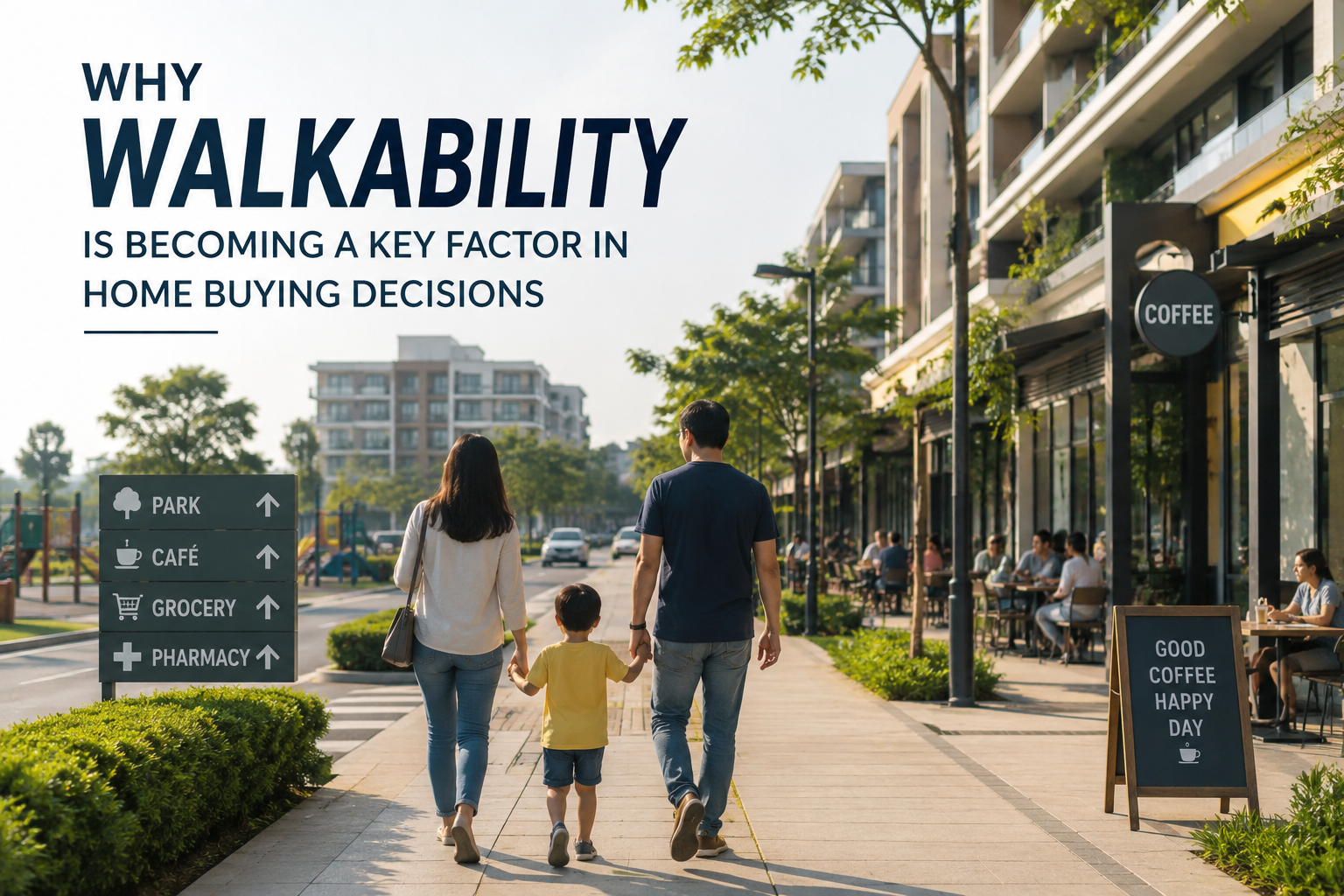
Why Walkability Is Becoming a Key Factor in Home Buying Decisions

A decade ago, most apartment buyers in India asked three questions: price, location, and square footage. Today, a fourth question is appearing more and more consistently how much can I do from here on foot? Walkability, the ability to reach daily needs without depending on a car, has become one of the most searched-for qualities in residential real estate globally. Understanding why this shift is happening and what it means for buyers in Mangaluru specifically can sharpen your property decision significantly.

Table of Contents

Why Walkability Has Moved From a Bonus to a Baseline Expectation

Walkability was once considered a pleasant bonus something buyers appreciated but rarely prioritised over price or space. That has changed decisively. A National Association of Realtors survey found that 79% of homebuyers now rate walkability as important, and 78% say they would pay more for a home in a walkable community. Among younger buyers, that figure rises to 90% making walkability one of the most consistent buyer preferences across age groups today.

The shift has been driven by a convergence of lifestyle changes. Rising fuel costs, increasing urban traffic congestion, remote and hybrid work patterns, and a growing focus on health-conscious living have all contributed to buyers placing higher value on being able to reach daily destinations on foot. What was once a characteristic of expensive urban addresses is now a baseline expectation across buyer demographics.

Walkability is no longer purely an aspiration it is a practical evaluation criterion. When choosing the right location for a property investment in Mangaluru, buyers are increasingly asking not just which neighbourhood is prestigious, but which one is genuinely liveable on a daily basis without a vehicle for every errand.

The definition of walkability in the Indian urban context is specific and practical. It means being able to walk to a grocery store, reach a school or a park on foot, find a medical clinic within ten minutes, and access daily services without planning a car trip for each one. Neighbourhoods that deliver this combination are becoming the most consistently sought-after residential addresses across Indian cities.

Walkability has moved from a lifestyle preference to a primary decision factor in home buying because daily life without car dependency is genuinely more convenient, healthier, and less expensive. Buyers who understand this are making location decisions with greater long-term confidence. Those who overlook it often discover its absence only after moving in when every errand requires a vehicle and every trip adds to daily fatigue.

How Walkability Directly Affects Property Value and Long-Term Returns

Walkability is not just a quality-of-life factor it has a measurable, documented impact on property values. Research from Redfin found that each additional Walk Score point adds an average of $3,250 to a home’s value, and homes in highly walkable areas have sold for roughly 23.5% more than comparable properties in car-dependent neighbourhoods. For buyers thinking about long-term investment returns, this is a number worth understanding.

The reason walkability adds value is straightforward: it broadens buyer appeal. A property that serves young professionals, growing families, elderly residents, and NRI investors equally well will always attract more competition at the time of resale than one that appeals to a narrower segment. Broader appeal means stronger offers, faster sales, and more resilient pricing during market slowdowns.

Among the factors that drive property appreciation in Mangaluru’s prime areas, location accessibility consistently ranks near the top. Neighbourhoods where residents can access daily needs on foot carry a premium that holds even when the broader market softens because the demand for such addresses is consistent across economic cycles.

During market downturns, walkable properties also retain value more effectively than car-dependent alternatives. When buyers are under financial pressure, the ability to reduce transport costs becomes an active financial benefit not just a lifestyle preference. A home in a walkable neighbourhood saves a household a meaningful amount annually on fuel, parking, and vehicle maintenance, and this savings gets factored into what buyers are willing to pay.

The Daily Life Impact — Health, Stress, and What You Save Every Month

The case for walkability is not only financial. The daily lived experience of a walkable neighbourhood is genuinely different from a car-dependent one and the difference compounds over years of living in the same place. Residents of walkable communities consistently report higher life satisfaction, lower stress levels, and better daily health outcomes than those in areas where a car is required for every task.

The health case is simple: walking as part of daily routine to the grocery store, to school, to the park contributes to physical activity levels that most working adults otherwise struggle to achieve. This is not gym activity; it is incidental movement built into the structure of daily life. Over months and years, this difference in baseline physical activity has meaningful health outcomes, particularly for families with young children or elderly members who spend more time in the neighbourhood.

The financial benefit of reduced car dependency is equally practical. A household that can complete daily errands on foot reduces fuel costs, reduces vehicle wear and maintenance expenses, and in some cases eliminates the need for a second vehicle entirely. How proximity to essential services adds measurable value to daily life, is a calculation that goes beyond property value it directly affects what a family spends every single month.

The social dimension matters too. Walkable neighbourhoods create natural opportunities for community interaction at a park, on a pavement, outside a local shop. This informal daily engagement builds a sense of belonging and community safety that apartment complexes in isolated locations rarely achieve. Residents know their neighbourhood and their neighbours, and that familiarity creates an environment that families want to stay in long term.

Who Cares Most About Walkability — And Why It Applies to Every Buyer Type

Young professionals and couples prioritise walkability for the urban convenience it enables the ability to walk to a café, a restaurant, a gym, or a colleague’s office without planning a car trip. For this demographic, a walkable address is also a social statement about the kind of lifestyle they are building. Why working professionals consistently choose apartments in Kadri over other areas in Mangaluru, is directly connected to the daily convenience that walkability in this location provides.

Families with children place the highest practical value on walkability because of school proximity. A home within walking distance of a good school eliminates one of the most time-consuming and stressful parts of a parent’s day  the school run. Proximity to parks and recreational spaces that children can access safely on foot adds a further dimension of daily quality that families with growing children feel every day. Families upgrading to larger homes in Mangaluru consistently cite neighbourhood walkability, as a primary factor in their location decision.

For retirees and elderly residents, walkability is not about lifestyle — it is about independence. The ability to reach a pharmacy, a clinic, a temple, a grocery store, or a park on foot without relying on a driver or a family member gives elderly residents a quality of daily life that no amount of interior premium can substitute for. This is why walkable addresses in established Mangaluru neighbourhoods like Kadri remain in strong demand from buyers purchasing homes for ageing parents.

Walkability in Mangaluru — Why Neighbourhood Choice Decides Everything

Localities like Kadri, Bejai, and Falnir offer residents the ability to reach daily essentials markets, temples, hospitals, schools, restaurants, and parks within minutes on foot. This proximity advantage has been built over decades of mixed-use neighbourhood development, where residential streets sit within natural walking distance of commercial and community infrastructure. It cannot be replicated in newly developed outskirts locations regardless of how good the apartment project itself is.

The lifestyle advantage that Kadri and Bejai offer residents who prioritise daily convenience, is precisely what walkability researchers describe as the highest-value residential characteristic everything you need, accessible without a car, in an established community with a strong sense of place. This is rare in Indian cities and increasingly so in Mangaluru as development spreads outward and central land becomes scarcer.

Limited land availability in Mangaluru’s prime residential pockets means that new supply in genuinely walkable neighbourhoods is extremely rare. Why Kadri remains one of Mangaluru’s most sought-after residential addresses, comes down to exactly this — the combination of established infrastructure, community character, and walkable daily access that cannot be rebuilt from scratch in a new development zone.

Conclusion

Walkability has become a key factor in home buying decisions because it affects daily life, long-term property value, physical health, and financial wellbeing simultaneously — in ways that are measurable and consistent across buyer types and market cycles. Buyers who factor it into their decision early make more confident choices. Those who discover its absence after moving in typically wish they had weighted it more heavily from the start.

In Mangaluru’s market, where genuinely walkable addresses in prime localities are limited and becoming rarer, the window to buy in these neighbourhoods at reasonable prices is narrowing.

A Walkable Address in Kadri — Udbhav Chinmaya

Udbhav Chinmaya on Swami Vivekanand Road, Chandrika Layout, Kadri is positioned at the centre of one of Mangaluru’s most walkable residential addresses — minutes from Kadri Park, Kadri Manjunath Temple, established schools, and major hospitals. With 40 exclusive 3 & 4 BHK apartments starting from ₹1.55 Crore*. It offers the daily walkability advantage of Kadri combined with premium low-density living.

25% payable at agreement, balance construction-linked. RERA registered. Loan-approved by SBI, Canara Bank, and Karnataka Bank. Possession December 2027.

👉Explore Udbhav Chinmaya

Share

Enquire Here

Udbhav Chinmaya - Highlights

Get In Touch

udbhav form

Name(Required)
Preferred Unit Type(Required)
Intended Use(Required)
Bank / Loan Preference(Required)
WhatsApp Consent(Required)