
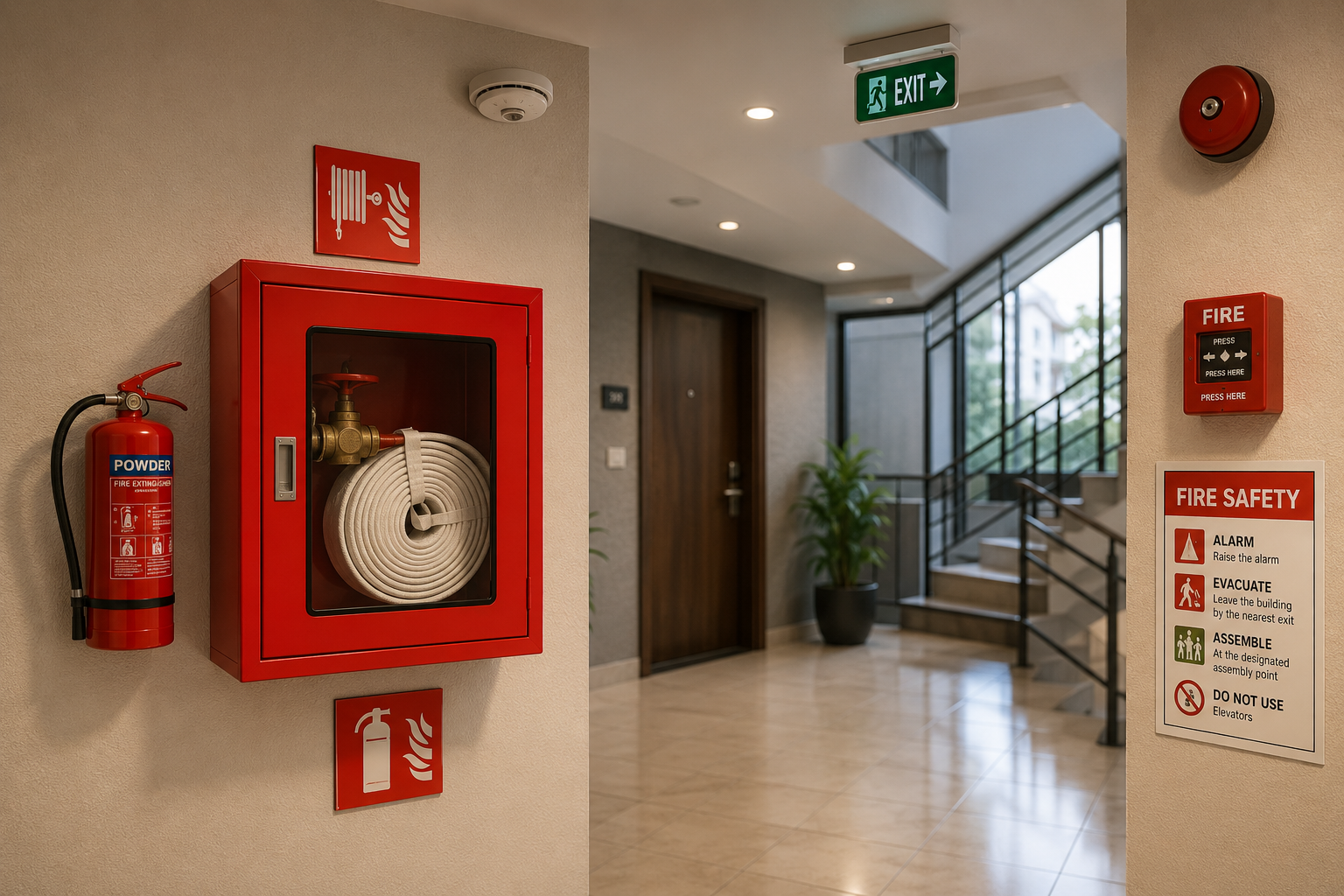
The Importance of Fire Safety Features in Residential Apartments
Most apartment buyers spend hours evaluating floor plans, amenities, and price. Few spend even five minutes asking about fire safety. Yet fire incidents in Indian residential buildings are rising year on year — and when a fire occurs in a multi-storey apartment, the outcome is determined almost entirely by decisions that were made before anyone moved in. Understanding what fire safety actually requires, what to verify before signing, and what questions to ask about maintenance is one of the most important things a family can do before buying an apartment.
Table of Contents
Why Apartment Buildings Are a Unique Fire Risk Environment
A residential apartment building is not simply a collection of individual homes stacked on top of each other it is a shared environment where a fire in any one unit can affect every occupant in the building.
The risks in a multi-storey apartment are fundamentally different from those in a single-family house, and they require a fundamentally different level of infrastructure to manage safely.
Understanding why requires understanding how fire behaves in shared vertical structures. Most residential fire fatalities occur not from direct flames but from smoke inhalation and toxic fumes which travel through stairwells, lift shafts, and service ducts faster than most occupants can move.
In a multi-storey building, smoke from a fire on the third floor can render upper floor stairwells impassable within minutes. apartment security and emergency systems that cover fire detection alongside access control and CCTV represent the full spectrum of safety infrastructure that every family should evaluate before booking.
What Indian Law Requires — NBC and the Fire NOC Explained
India’s National Building Code updated in both 2016 and 2025 establishes mandatory fire safety requirements for residential apartment buildings that go well beyond installing a smoke detector. For buildings above 15 metres in height, the requirements are comprehensive and legally enforceable. Understanding what the code requires gives buyers a clear benchmark against which to evaluate any project.
The NBC mandates that high-rise residential buildings be equipped with smoke detectors, a public address system, automatic sprinklers, first aid firefighting equipment, fire pumps, clearly marked escape routes, and a dedicated fireman’s lift.
A Fire NOC — No Objection Certificate from the local fire authority is a mandatory pre-occupation requirement and must be renewed periodically. Legal checks before buying property should always include verifying that the developer holds a current Fire NOC for the project and buyers should ask to see this document, not simply accept an assurance that it exists.
State regulations frequently exceed NBC minimums, and penalties for non-compliance range from ₹10,000 to over ₹10,00,000 depending on the nature and severity of the violation.
RERA registration requires developers to disclose construction standards and safety specifications — and fire safety compliance is part of what RERA-registered projects are accountable for. RERA approved properties provide buyers with a legal framework for verifying disclosed safety specifications against what is actually installed.
Smoke Detection and Alarms — The First Line of Defence
Smoke detection is the first and most critical line of fire defence in any residential building because a fire identified at its incipient stage gives occupants the time to evacuate safely. A system that detects fire in 60 seconds versus one that detects it in 6 minutes represents the difference between an orderly evacuation and a life-threatening situation. This is not an exaggeration; it is the documented basis on which fire safety codes are built.
Modern apartment buildings must install interconnected smoke detectors systems where any triggered detector alerts the entire building simultaneously, not just the immediate area. These are designed to detect fires in their earliest stages, before flames develop and smoke becomes dangerous. Manual call points — push-button alarm triggers — must be reachable within 30 metres of travel on every floor, not just positioned near exits or in common areas.
When evaluating a project, ask whether the fire alarm panel is addressable or conventional, where smoke detectors are installed, and when the alarm system was last tested. A fire alarm panel showing persistent fault indicators a common finding in poorly maintained buildings — is a critical compliance failure. what to check before buying a 3 or 4 BHK apartment should include asking specifically about the fire alarm system type and the date of the most recent maintenance service.
Sprinklers and Suppression — Systems That Only Work When Maintained
Sprinkler systems are among the most effective fire safety features in residential buildings but only when they are correctly installed, regularly maintained, and operationally ready. A sprinkler system that activates automatically when a fire reaches threshold temperature can suppress or extinguish a fire before firefighters arrive, buying critical evacuation time. A sprinkler system that has not been maintained cannot do any of this — and its presence gives residents a false sense of security that may be more dangerous than having no system at all.
Sprinklers are mandatory in basements and parking areas of larger residential complexes, and increasingly standard across common area floors in well-specified buildings. The system works through individual heat-sensitive heads — each activates independently when the temperature at that location reaches the threshold, meaning only the heads directly over a fire activate, not the entire building. This precision makes them highly effective and minimises water damage in unaffected areas.
Common maintenance failures include painted-over sprinkler heads that cannot open when heat activates them, control valves left in the closed position after an accidental activation years earlier, and jockey pumps that have not been tested under load since the building was commissioned. Each of these failures renders the suppression system ineffective without making it visibly obvious to residents. Ask when the sprinkler system was last tested under load, whether all control valves are in the open position, and whether pump test certificates are current.
Fire hydrant systems — providing water access for manual firefighting on every floor — complement the automatic suppression infrastructure. CO₂ and clean agent suppression systems in electrical panel rooms and server areas protect against fire types that water-based systems cannot safely address. A complete suppression infrastructure covers both automatic and manual firefighting capability across all areas of the building — not just the common areas that are most visible to prospective buyers.
Fire Exits and Evacuation Routes — What to Check Beyond the Brochure
Fire exits and evacuation routes are the infrastructure that determines whether residents can actually leave a building safely when a fire occurs. Their design is governed by the National Building Code; their effectiveness in an emergency is determined by whether they are maintained and kept clear every day. These are two very different things, and the gap between them is where the most common evacuation failures occur.
For residential buildings above 15 metres, the NBC requires protected stairways — fire-resistant stairwells that remain structurally safe during a fire and are designed to limit smoke ingress. Emergency lighting systems with battery backup ensure these stairwells remain navigable even when the main power supply fails — which frequently happens during fire incidents. Illuminated exit signs with battery backup must be clearly visible at all corridor decision points, particularly in smoke-filled conditions where visibility is dramatically reduced.
Exit routes must be completely clear at all times. The most common evacuation failure in Indian residential buildings is not a missing exit but a blocked one — bicycles stored in stairwells, deliveries placed in exit corridors, locked grilles installed for security that prevent escape during emergencies. A physical walk-through of a building’s exit routes during a site visit reveals far more about its evacuation readiness than any documentation review. fire safety as part of modern apartment standards is now a baseline expectation that buyers should verify physically, not just tick off a checklist.
A fireman’s lift — distinct from passenger lifts and designed to function during a fire — allows fire department personnel to reach upper floors without using staircases, significantly improving response capability in taller buildings. Ask whether the building has a dedicated fireman’s lift, whether evacuation routes are tested regularly through drills, and whether the building has an emergency evacuation plan posted in common areas. The answers reveal whether fire safety has been treated as an active operational priority or merely a construction-phase compliance item.
Maintenance Culture — The Real Test of Fire Safety
The most dangerous gap in residential fire safety is not the absence of equipment it is the presence of equipment that no longer functions. A building with every required fire safety feature installed at handover can be genuinely dangerous five years later if those features have not been maintained. Maintenance culture is the real test of a building’s fire safety and it is entirely invisible on a site visit unless you know what questions to ask.
Common maintenance failures that render fire safety systems ineffective include fire alarm panels showing persistent fault indicators that nobody has investigated, jockey pumps that have not run under load since commissioning, fire extinguishers with service certificates expired by a year or more, and emergency lighting units with dead batteries. Each of these is a documented compliance failure but none of them is visible from a corridor walk-through. The required documentation fire pump test certificates, extinguisher service records, alarm panel maintenance logs, and the emergency evacuation plan with the last drill date tells the real story.
Apartment maintenance charges and what they cover should always include a specific allocation for fire safety system servicing. A building where maintenance charges are unrealistically low is often a building where scheduled fire safety servicing has been deferred or skipped entirely because these are the costs that building committees most often cut first. Ask the developer or association specifically what the annual fire safety maintenance budget is and when the last full fire system service was completed.
Conclusion
Fire safety in residential apartments is not a single feature or a compliance certificate — it is a system of detection, suppression, evacuation infrastructure, and ongoing maintenance that must all function together when it is needed most. For families buying an apartment in Mangaluru, verifying this system before signing is as important as evaluating the floor plan or the location. The questions are straightforward: Is there a current Fire NOC? Are the smoke detection and sprinkler systems maintained? Are exit routes clear and tested? A developer who can answer these clearly and specifically has built a building worth trusting with your family’s safety.
Fire Safety Built In — Udbhav Chinmaya, Kadri, Mangaluru
Udbhav Chinmaya is designed with fire safety infrastructure compliant with Karnataka building regulations — smoke detectors, fire suppression systems, clearly marked evacuation routes, emergency lighting, and fire safety systems certified at the time of handover. As a Ground+5 low-rise structure with only 40 apartments, the building’s compact configuration supports faster evacuation and more manageable emergency response than large high-density towers. RERA registered (PRM/KA/RERA/1257/334/PR/311225/008371) and developed by Udbhav Developers — a CREDAI Mangalore member with over a decade of completed projects in the city.
3 & 4 BHK apartments starting from ₹1.55 Crore*, with 25% payable at agreement and the balance through a construction-linked payment plan. Loan-approved by SBI, Canara Bank, and Karnataka Bank. Possession December 2027.