
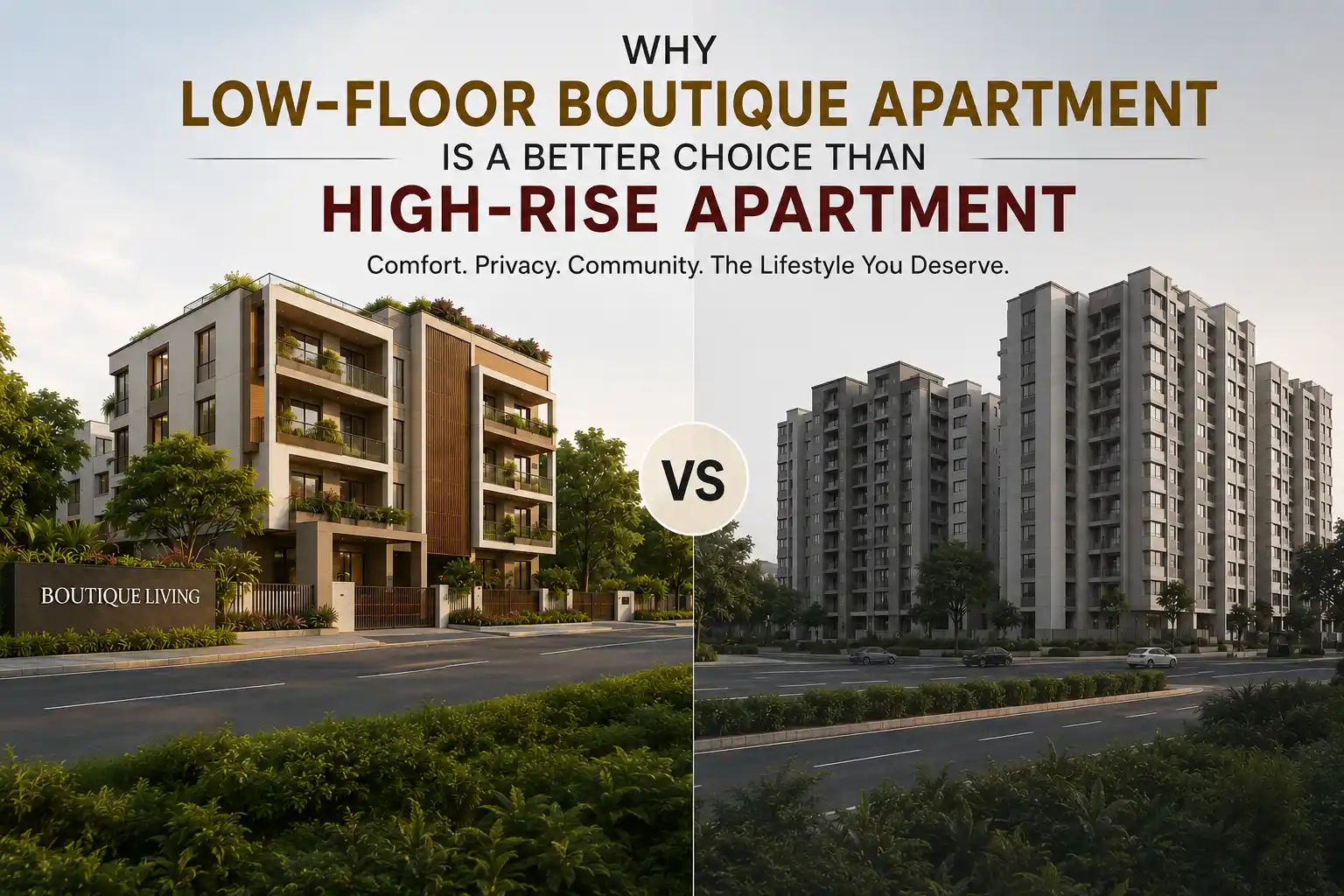
Why Low-Floor Boutique Apartment Is Better Choice Than High-rise Apartment
If you are looking to choose between a low-rise and high-rise apartment, this message will help you come to the decision of choosing the right apartment that fits your life goals. The choice between a low-rise and a high-rise apartment is one of the most consequential decisions a buyer makes and one of the least carefully evaluated. This guide compares both options honestly so you can make the decision that fits how you actually want to live.
Table of Contents
- Property Value Appreciation
- Head-to-Head Appreciation Comparison
- Elevator Dependency — The Daily Friction Most Buyers Underestimate
- Community and Maintenance — Where Low-Rise Wins Every Time
- Premium Amenities — The Difference Between Access and Experience
- Low-Floor Boutique Apartment at the Right Location — Where Quiet Becomes Luxury
Property Value Appreciation
Low-rise Luxury Boutique Apartments: These properties gain value through extreme localized scarcity. Since prime residential zones have highly constrained land availability, a low-density, quiet project featuring high-end materials and full club amenities behaves more like a “vertical villa”. It commands premium resale pricing from affluent locals, Gulf returnees, and NRIs who prioritize privacy and best neighborhood.
Luxury High-Rise Towers: These properties are evaluated based on brand power, landmark status, and sweeping coastal/city views. High-rises scale quickly in value during the initial years due to high visibility and mass market appeal among corporate and medical professionals moving into the city. However, long-term appreciation can face headwinds once newer, taller towers launch nearby, shifting the “novelty premium” away from the older building.
Head-to-Head Appreciation Comparison
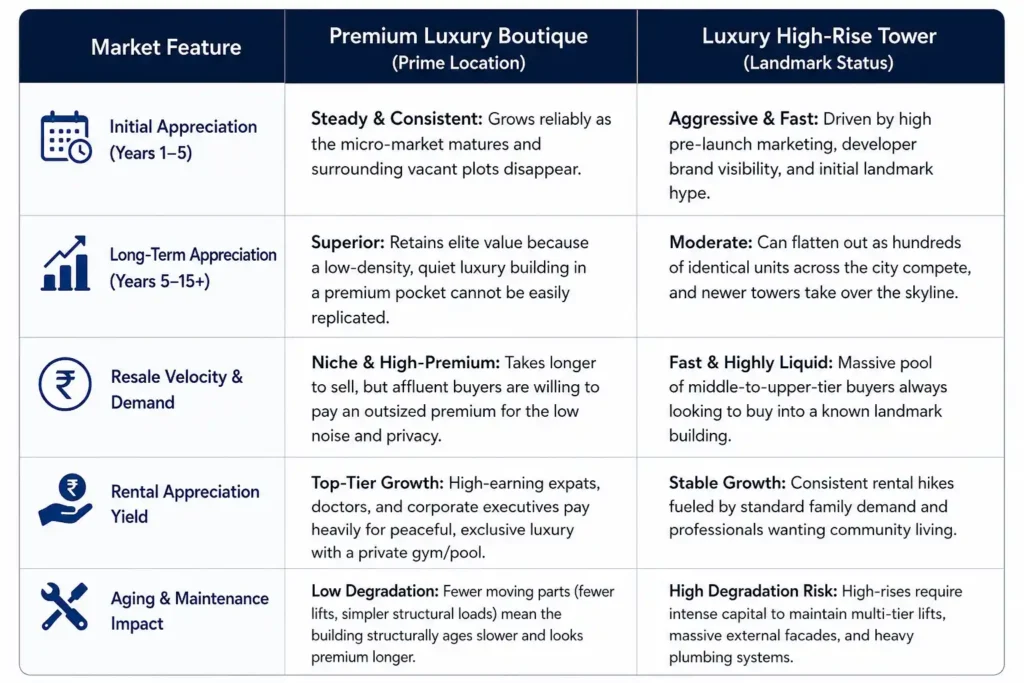
If your property is in a hyper-premium, land-locked area like Kadri or Bendoorwell, the luxury boutique project will likely yield higher long-term appreciation per square foot due to sheer exclusivity. If the project is in a rapidly developing corridor where a spectacular sea view or city view is the main selling point, the high-rise tower holds the upper hand for quick, liquid capital gains
Vastu — Why Low-Rise Buildings Get It Right More Often
Vastu compliance is one of the most consistently cited buyer priorities in India — and one of the most consistently compromised in high-rise construction.
In a high-rise tower, a truly Vastu-compliant unit means the right orientation, the right floor, the right corner, and the right direction of entry. That combination applies to a small fraction of total inventory. Everyone else accepts a compromise.
Low-rise apartment buildings with fewer units can be designed for Vastu comprehensively from the outset. With fewer than 50 units across 5 floors, a developer can orient the entire structure and design every unit with Vastu-compliant apartment design in Mangaluru illustrates exactly this — fewer units, deliberate orientation, and no compromised corners.
Fire Safety — Why Fewer Floors Change the Evacuation Equation
Lower floors and fewer storeys are safer by physics. Evacuating from a Ground+5 structure takes minutes. Evacuating hundreds of residents from a 25-storey tower down narrow stairwells, in a fire, at night, is a fundamentally different — and fundamentally harder — operation. India’s National Building Code recognises this by applying stricter fire safety requirements to buildings above 15 metres.
Stricter requirements do not automatically mean safer buildings. They set a minimum standard. Fire safety features that actually matter in residential apartments makes this distinction clearly — compliance certificates confirm what was installed, not whether it is maintained. A well-maintained low-rise apartment will outperform a poorly maintained high-rise every time, regardless of their respective compliance paperwork.
Lower floors also offer faster independent egress — a consideration that matters most for the residents who need it most. Elderly family members, young children, and anyone with mobility limitations benefit every single day from stairs as a practical option rather than a last resort. This is not a theoretical safety advantage — it is a daily practical one that families with parents or grandchildren feel constantly.
Elevator Dependency — The Daily Friction Most Buyers Underestimate
High-floor apartments in high-rises depend entirely on lifts. That dependency reveals itself most painfully in three situations — peak morning hours, power outages, and maintenance shutdowns. In a 200-unit tower with two lifts, the morning rush between 8 and 9 AM creates queues that add 10 to 15 minutes to a resident’s routine. Over a working year, that is days of waiting for a lift to arrive.
Most buyers imagine living on the 18th floor from the weekend morning perspective — quiet, elevated, with a view and a coffee. They do not imagine it from the Tuesday morning commute perspective — already late, watching the lift display cycle between floors, carrying a laptop bag and a lunchbox. Elevator reliability as part of apartment amenity quality covers this — lift brand, capacity, and service contract are specifications worth verifying before signing.
Low-rise buildings — particularly Ground+5 structures — make lift dependency optional rather than absolute. A resident on the third floor walks up in under two minutes.
Community and Maintenance — Where Low-Rise Wins Every Time
Low-rise communities are quieter, more private, and easier to live in because fewer people share the space. Security staff in a 40-unit building know every resident by face and name. An unfamiliar visitor in the corridor is noticed immediately. In a 200-unit tower, anonymity is structural, and that anonymity makes access control genuinely harder, regardless of how sophisticated the biometric system is.
Low-density apartment living and its security advantage documents this directly — fewer residents means security staff can maintain genuine familiarity, which is one of the most effective deterrents available. This is not a feature you can install in a large complex. It comes from size — and size is a developer decision made before the first floor plan is drawn.
Maintenance charges follow the same logic. High-rises run multiple lifts, large generators, bigger security teams, complex mechanical systems, and often apply floor-rise premiums to upper-floor buyers on top of everything else. How maintenance charges are structured and what drives them is worth reading before comparing projects. A low-rise with 40 units has simpler infrastructure, a smaller resident base sharing costs, and fewer mechanical systems requiring ongoing servicing — resulting in consistently lower monthly maintenance contributions for every owner.
Premium Amenities — The Difference Between Access and Experience
Most high-rise apartments don’t tell you how many people are sharing each amenity. A gym with 8 machines for 40 families is a useful place to go every day. The same gym for 300 families becomes a problem when it comes to scheduling.
What premium amenities really look like in a low-density building is about how many people are using them — a detail that most developers hope buyers won’t think about before buying.
Privacy in shared spaces isn’t something you can just add. It happens naturally because of how many people are in the building. A mom using the kids’ play area in a boutique building knows most of the other kids and parents. An older person going to the gym at 7 AM might have it to themselves. A family hosting an event in the clubhouse doesn’t have to worry about three other bookings on the same Saturday.
Premium 3 and 4 BHK apartments in Kadri with resort-style amenities — that’s what amenity exclusivity really means.
Low-Floor Boutique Apartment at the Right Location — Where Quiet Becomes Luxury
There’s a type of apartment that’s rarely described properly — buildings that are right in the middle of the city but feel completely different.
There is no question of lots of neighbours, a constantly busy elevator, crowded parking, and the constant background noise of a fully occupied building. Finding a low-floor boutique apartment at the right place has all the convenience and advantages a buyer needs.
Which Is the Better Choice for You?
If you’re buying an apartment for any of the following reasons:
- For long-term value
- To raise kids
- To house aging parents
- To come home to after a busy day
- To live a peaceful, luxurious life with city connectivity
…a low-floor boutique apartment in the right location is indeed a better choice.
Privacy of Living in a Low-Floor Boutique Luxury Apartment
Security staff who know your name. An elevator that comes when you need it. Elderly parents who can reach the ground floor easily. Neighbours you actually know. A maintenance charge that doesn’t catch you off guard every quarter. City access without city noise. These are advantages of low-density living, and they’re only available in areas where the developer chose to build that way.
Udbhav Chinmaya is a Ground+5 structure with 40 exclusive 3 & 4 BHK luxury boutique apartments on 64 cents of land in Kadri, Mangaluru. Every advantage this blog describes — Vastu-compliant design, safety, privacy, lift-optional daily access, community familiarity, and lower maintenance — is built into the project by design.
Premium low-rise apartments in Kadri, Mangaluru — starting from ₹1.60 Crore*, 25% at agreement, construction-linked balance. RERA registered. Loan-approved by SBI, Canara Bank, and Karnataka Bank. Possession December 2027.
Explore floor plans and book a site visit — see the building, the location, and the construction quality for yourself before deciding.