

Mangaluru has quietly become one of South India’s most consistent real estate markets — and for investors evaluating rental income, the numbers are worth understanding precisely. Yield figures get cited in property discussions, but the same locality can show very different numbers depending on who is doing the calculation and what they are leaving out. This guide gives you the real data, the methodology behind it, and the factors that determine whether a Mangaluru investment actually delivers the return it promises.
Table of Contents
What Rental Yield Actually Means — How to Calculate It
Rental yield is annual rent expressed as a percentage of the property’s purchase price. A flat bought for ₹1 crore generating ₹50,000 per month produces ₹6 lakh annually — a 6% gross yield. That headline number is where most investor conversations start — and unfortunately where many of them also stop.
Net yield is the number that reflects actual investor cash flow. It deducts monthly maintenance charges — typically ₹3,000 to ₹8,000 per month in a premium Mangaluru building — plus property tax, vacancy periods between tenants, and any management fees. A gross yield of 4% in a well-located Mangaluru apartment can net to 2.8–3.2% after realistic deductions. Understanding apartment maintenance charges and what they include directly affects your net yield calculation — buyers who understand this before investing avoid the most common return disappointment.
Vacancy periods are the most impactful yield reducer — and the most consistently underestimated. One month of vacancy in a year reduces an otherwise 4% gross yield to approximately 3.7%.
Two months of vacancy takes it to 3.3%. Understanding vacancy risk in specific localities — which areas have consistent tenant demand and which have seasonal gaps — is as important as knowing the headline yield figure.
Rental Yield by Locality — The Real Numbers for Mangaluru in 2026
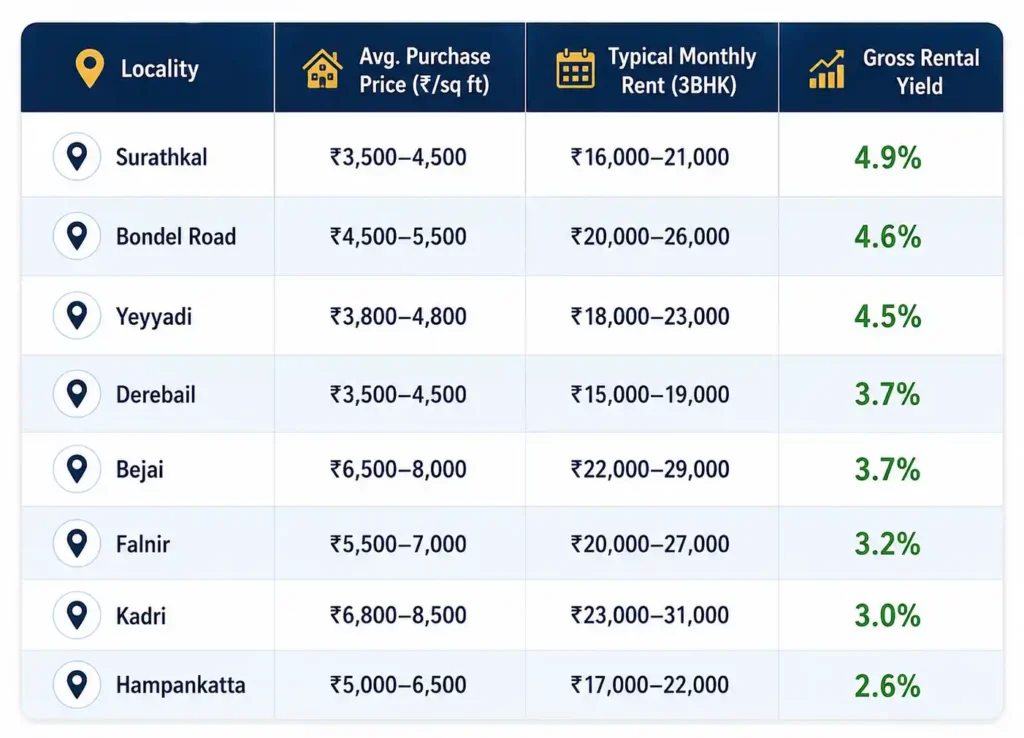
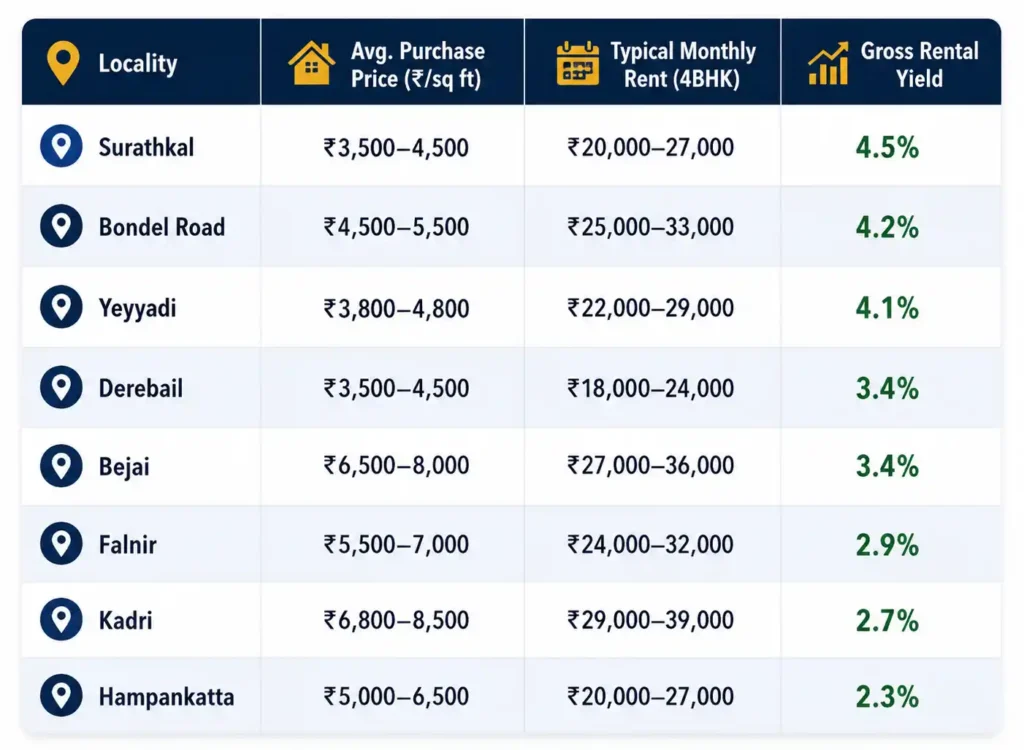
Mangaluru’s rental yield varies more by micro-market than most investors expect. Surathkal leads the city at 5.3%, driven entirely by NITK’s consistent student and faculty housing demand.
Bondel Road (5.0%), Yeyyadi (4.9%), Derebail (4.0%), and Bejai (4.0%) follow — each supported by specific demand drivers that generate tenant density in those corridors.
Central premium localities — Kadri, Falnir, Hampankatta — show yields of 2.5–3.5%, which is lower than Surathkal but reflects higher purchase prices rather than weaker rental demand.
Rent in Kadri is strong; what compresses the yield is the higher per-square-foot price that buyers pay for the location premium. Understanding what determines apartment prices in Mangaluru in 2026 explains why central localities command purchase price premiums — factors that directly affect the yield a buyer can achieve at a given entry price.
The yield figures in circulation for the same locality can vary by 1–2 percentage points depending on the methodology — whether maintenance is deducted, whether vacancy is factored in, and whether the denominator is the original purchase price or current market value.
Before using any yield figure as an investment basis, confirm what it includes and what it excludes. A 5.3% gross yield from Surathkal and a 3.5% net yield from Kadri are not directly comparable without reconciling the methodology.
Gross Yield by Locality (3 BHK)
Gross Yield by Locality (4 BHK)
Who Rents in Mangaluru — The Tenant Profile That Drives Yield
Mangaluru’s rental demand is driven by a specific set of occupant categories — each concentrated in different city pockets. Understanding who is renting in a specific area tells an investor more about vacancy risk and achievable rent than any headline yield figure. Tenant profile determines tenure length, maintenance behaviour, and the reliability of rental income over time.
Medical students, hospital staff, and healthcare professionals generate the most consistent and longest-tenure rental demand in central Mangaluru. Proximity to KMC Hospital, Fr Muller’s Medical College, and Wenlock District Hospital creates stable occupancy in Kadri, Falnir, and adjacent areas.
Healthcare tenants tend to stay for 2–4 years — longer than average — because their institutional attachment to the area does not change with job moves. This is directly connected to the healthcare and education ecosystem that makes Kadri one of Mangaluru’s most sought-after residential addresses, and creates persistent rental demand.
NITK students, researchers, and faculty drive Surathkal’s exceptional 5.3% yield — but this also means a student-heavy demand profile with 1-year academic cycle tenancies and annual vacancy risk at end-of-semester. IT professionals and port workers create demand in Derebail and Yeyyadi — a more stable profile with longer-tenure employment anchors.
For investors prioritising low vacancy and consistent cash flow over peak yield, the healthcare-adjacent localities of central Mangaluru have a structural tenant quality advantage over the yield-optimised student corridors.
Yield Plus Appreciation — The Combined Return That Makes Mangaluru Competitive
Rental yield is one return stream. Capital appreciation is the other. Mangaluru investors who evaluate only one of these consistently underestimate — or overestimate — the actual total return their investment delivers over a 7 to 10 year holding period.
Kadri has delivered 26.1% price appreciation over 3 years — approximately 8% per year — alongside a net yield of 3–4%. Adding these two return streams produces an annual total return of 11–15% depending on entry price and achieved rent. This is backed by the structural drivers behind property appreciation in Mangaluru’s prime areas — limited land, consistent end-user demand, and NRI buying — all of which continue to support Kadri’s pricing in 2026 and beyond.
For NRI investors, capital appreciation carries additional weight. A higher property value at exit means more repatriable proceeds under India’s USD 1 million annual repatriation limit. Premium 3 and 4 BHK apartments in Kadri, Mangaluru that combine a prime location, low-density design, and quality construction deliver both return streams — yield during the holding period and meaningful appreciation at exit.
This dual return profile is what makes Mangaluru’s established localities genuinely competitive against fixed-income alternatives for NRI investors managing wealth across jurisdictions.
What Drives Rental Yield Up — And What Cuts It Down
Proximity to demand drivers is the primary determinant of achievable rent and therefore yield. Apartments within walking distance of a major hospital, university, or corporate employer command consistently stronger rents than equivalent properties in areas without these anchors. Walkability and proximity to amenities as a property value driver applies equally to rental demand — tenants prioritise the same daily conveniences that owner-occupiers do.
Building quality directly affects the rent a property can achieve in any given location. A well-maintained premium building with 24/7 security, covered parking, and functional amenities commands 20–30% more rent than a basic building on the same street. 3 and 4 BHK apartments in Kadri with premium amenities and security represent the upper end of achievable rent in Mangaluru’s central market — where tenant demand from healthcare and business professionals supports consistent premium rents. This quality premium compresses the purchase price premium relative to achievable rent, supporting better net yields than the raw price comparison suggests.
Low-density buildings also deliver a rental advantage. With fewer units available for rent within the same building at any given time, a boutique project creates natural scarcity that supports rental pricing. Understanding how low-density living affects investment value helps explain this pattern — fewer competing units in the same building means landlords can hold rental rates without the pressure that oversupply within a single large complex creates. A landlord in a 40-unit building is in a fundamentally stronger negotiating position than one in a 200-unit tower where 20 identical units may be on the rental market simultaneously.
Conclusion
Rental yield in Mangaluru ranges from 2.5% in lower-demand central areas to 5.3% in Surathkal — and the number that matters for any specific investment is net yield after deductions, not gross yield from a brochure. The best Mangaluru investments combine a realistic net yield with consistent capital appreciation, low vacancy risk from a stable tenant profile, and a quality building that commands premium rents. Investors who evaluate all three factors together — rather than chasing the highest headline yield figure — consistently outperform those who do not.
A Kadri Investment Built for Total Return — Udbhav Chinmaya
Udbhav Chinmaya in Kadri sits at the intersection of Mangaluru’s strongest rental demand — healthcare professionals, established families, and NRI buyers — in one of the city’s highest-appreciating micro-markets. With 40 exclusive 3 & 4 BHK apartments in Kadri, premium amenities, biometric access, and RCC construction, the project delivers the quality premium that commands top-of-market rents in this locality.
Apartments from ₹1.60 Crore*, 25% at agreement, construction-linked balance. RERA registered. Loan-approved by SBI, Canara Bank, and Karnataka Bank. Possession December 2027.
3 & 4 BHK apartments from ₹1.60 Crore*. 25% at agreement, balance construction-linked.
👉 Explore Udbhav Chinmaya — Verify the RERA, Visit the Site →


