
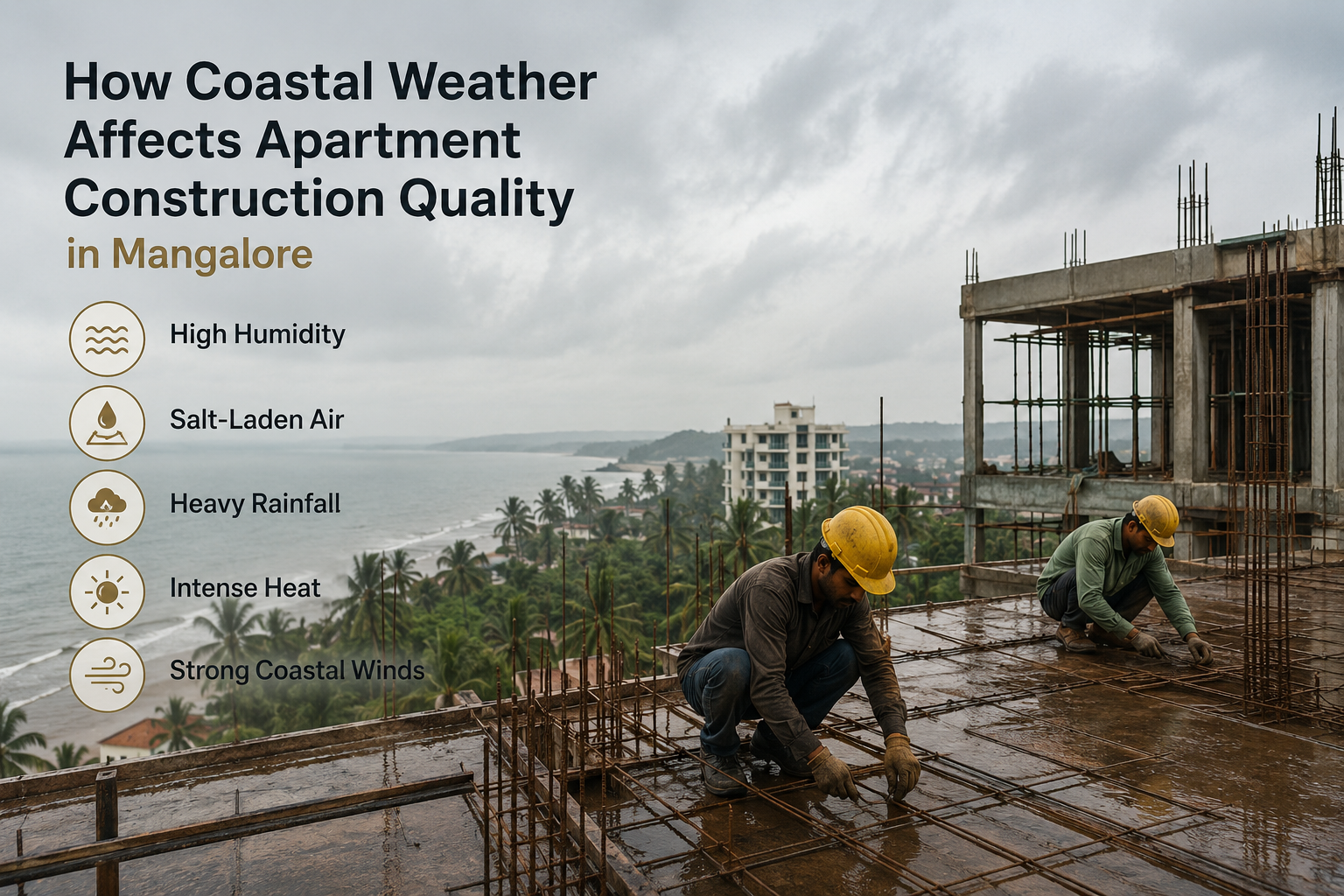
How Coastal Weather Affects Apartment Construction Quality in Mangalore
Mangaluru is undeniably one of India’s most beautiful coastal cities, characterized by the Arabian Sea to the west and the lush Western Ghats to the east. However, beneath the scenic palm-fringed landscapes and pleasant evening breezes lies one of the country’s most demanding environments for real estate.
When evaluating a new home in this region, buyers must look beyond the aesthetic appeal of the facade and the layout of the living room. The coastal climate radically shifts the focus toward structural integrity. Understanding how coastal weather affects apartment construction is crucial for ensuring your investment is built to genuinely last.
Table of Contents
- The Unique Climate Challenges in Mangaluru
- 1. High Airborne Salinity and Steel Corrosion
- 2. Extreme Monsoons and Water Seepage
- 3. Coastal Humidity and Material Degradation
- What Makes Coastal Apartment Construction Truly Resilient?
- Marine-Grade TMT Steel and High-Density Concrete
- Advanced Waterproofing and Damp-Proofing Strategies
- 1. Why is salt in the air bad for apartment buildings?
- 2. What type of steel is best for coastal apartment construction?
- 3. How do builders prevent water seepage during Mangalore monsoons?
- 4. Does humidity affect the interior finishes of an apartment?
The Unique Climate Challenges in Mangaluru
Coastal cities present a trifecta of environmental stressors that actively degrade standard building materials. If an apartment building is constructed using inland standards, it will rapidly show signs of premature aging, requiring heavy maintenance within the first few years.
1. High Airborne Salinity and Steel Corrosion
The constant sea breeze in Mangalore carries microscopic salt particles inland. When this airborne salinity penetrates porous concrete, it reaches the reinforcing steel framework. Salt acts as a rapid catalyst for oxidation (rusting). As standard steel rusts, it expands up to six times its original volume, causing the surrounding concrete to crack and spall—a structural hazard known as “concrete cancer.”
2. Extreme Monsoons and Water Seepage
Mangaluru receives heavy, relentless rainfall for four to five months a year. This continuous deluge tests every joint, window frame, and terrace. In subpar apartment construction, high-velocity wind-driven rain forces moisture through micro-cracks in the exterior plaster. Over time, this leads to internal dampness, bubbling paint, and weakened masonry.
3. Coastal Humidity and Material Degradation
With humidity levels frequently lingering between 75% and 90%, the air itself holds substantial moisture. This constant dampness creates an ideal breeding ground for mold, fungus, and algae on exterior walls. Furthermore, untreated timber warps, and standard metal fixtures degrade rapidly when exposed to persistent atmospheric moisture.
What Makes Coastal Apartment Construction Truly Resilient?
To combat Mangalore’s aggressive climate, premium builders engineer their projects specifically for coastal survival. Here is what goes into a weather-resilient building:
Marine-Grade TMT Steel and High-Density Concrete
To prevent salt-induced corrosion, high-quality construction utilizes corrosion-resistant TMT (Thermo Mechanically Treated) steel bars and high-density, low-porosity concrete (like M40 grade). A thicker “concrete cover” (the distance between the outer surface of the concrete and the steel inside) is strictly maintained to ensure salt and moisture cannot reach the structural core.
Advanced Waterproofing and Damp-Proofing Strategies
Resilient apartment construction does not rely solely on exterior paint to keep water out. It requires a multi-tiered waterproofing approach:
Crystalline Waterproofing: Applied to foundations and retaining walls to block capillary moisture from the soil.
Double-Coat Plastering: External walls are often constructed with laterite stone and finished with double plastering to create a thick barrier against wind-driven monsoons.
Terrace and Wet-Area Sealing: Bathrooms, balconies, and rooftops undergo rigorous membrane waterproofing to prevent vertical seepage.
Anti-Fungal Paints and Coastal-Grade Finishes
Aesthetically, buildings in Mangalore require specialized exterior coatings. High-performance, anti-algal, and weather-proof elastomeric paints are utilized to stretch over micro-cracks and reflect UV rays, keeping the building’s exterior pristine despite the relentless sun and rain. Internally, UPVC or high-grade aluminum windows are favored over standard wood to prevent warping and swelling during the wet season.
How Udbhav Developers Masters Coastal Building Standards
At Udbhav Developers, we believe that luxury is fundamentally rooted in uncompromising quality. Since 2012, our projects across Mangalore from the serene Udbhav Shanthi to the premium, low-density residences of Udbhav Chinmaya have been engineered to thrive in the coastal climate.
We invest heavily in the foundational aspects of our buildings that you cannot see. By utilizing premium materials, rigorously tested RCC frameworks, laterite stone masonry, and advanced weather-proofing techniques, we ensure our apartment construction stands resilient against Mangaluru’s toughest monsoons and coastal winds. We deliver homes that require minimal maintenance, provide maximum acoustic privacy, and yield long-term property value.
When you invest in a coastal home, you are investing in the engineering that protects it. Choose a builder who designs for the environment, not just the aesthetic.