

A Comprehensive Guide to Real Estate Tax Benefits in India
Buying a residential property is one of the most significant financial milestones a family can achieve. However, beyond long-term capital appreciation and rental yield, real estate offers a key financial advantage that is often underutilized: significant income tax savings.
Under the Indian Income Tax Act, home buyers and real estate investors can leverage specific deductions to reduce their taxable income by lakhs of rupees every financial year. Whether you are buying your first luxury apartment in Mangaluru or expanding an investment portfolio, understanding how to navigate real estate tax provisions can lower your actual cost of ownership.
Here is a breakdown of the primary real estate tax benefits in India and how you can maximize them.
Table of Contents
- Key Income Tax Deductions for Homebuyers
- Advanced Tax Saving Strategies for Property Investors
- 1. Multiply Savings via Joint Home Loans
- Pre-Construction Interest Tax Deductions
- Build Long-Term Wealth with Udbhav Developers
- FAQs
- What is the maximum real estate tax benefit on a home loan in India?
- Can joint home loan co-owners claim real estate tax deductions separately?
- How does tax deduction work for under-construction properties in Mangaluru?
- What is the 30% standard deduction on rental income under real estate tax laws?
- How can I avoid capital gains tax when selling real estate in India?
Key Income Tax Deductions for Homebuyers
When purchasing property through a housing loan, the Indian tax code allows you to claim tax relief on both the interest component and the principal repayment component of your Equated Monthly Installment (EMI).
1. Section 24(b): Deduction on Home Loan Interest (Up to ₹2 Lakhs)
Under Section 24(b) of the Income Tax Act, property owners can claim a tax deduction of up to ₹2,000,000 (₹2 Lakhs) per financial year on the interest paid towards a home loan for a self-occupied property.
Self-Occupied Property: Capped at ₹2 Lakhs annually.
Let-Out/Rented Property: There is no maximum upper limit on the interest deduction you can claim against rental income, subject to overall loss set-off rules under prevailing tax regulations.
2. Section 80C: Tax Relief on Principal Repayment (Up to ₹1.5 Lakhs)
While Section 24(b) covers home loan interest, Section 80C provides tax relief on the principal component of your home loan repayment.
Maximum Limit: Up to ₹1,50,000 (₹1.5 Lakhs) per financial year.
Conditions: The property must not be sold within 5 years of taking possession; otherwise, the claimed deductions will be added back to your taxable income in the year of sale.
3. Tax Deductions on Stamp Duty and Registration Charges
Stamp duty and registration fees form a major portion of upfront acquisition costs. Under Section 80C, you can claim a one-time tax deduction on stamp duty and registration expenses paid during the year of purchase, within the overall ₹1.5 Lakh ceiling.
Advanced Tax Saving Strategies for Property Investors
Strategic property structuring allows families and seasoned real estate investors to expand their overall tax write-offs legally.
1. Multiply Savings via Joint Home Loans
If you purchase a property jointly with a family member (such as a spouse, parent, or sibling) and both are co-borrowers paying EMIs, each co-owner can individually claim tax benefits:
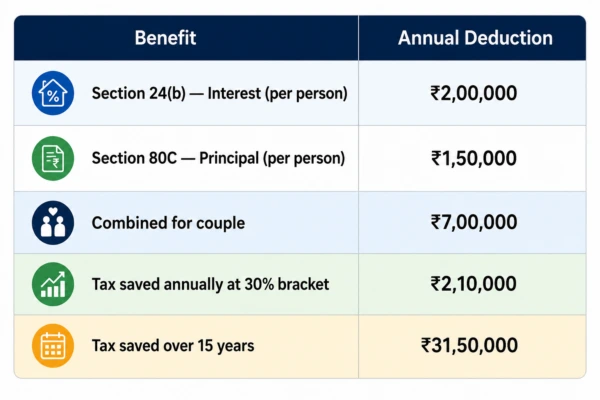
Combined Interest Deduction (Section 24b): Up to ₹4 Lakhs (₹2 Lakhs each).
Combined Principal Deduction (Section 80C): Up to ₹3 Lakhs (₹1.5 Lakhs each).
This structure effectively doubles the tax shelter for a single residential unit.
2. Standard 30% Deduction on Rental Income (Section 24a)
If you invest in real estate to generate rental income, the tax code provides an automatic buffer. Under Section 24(a), a flat 30% standard deduction is applied to the Net Annual Value (Gross Rent minus Municipal Taxes) of the property. This 30% deduction is allowed regardless of your actual expenditure on property repairs or maintenance.
3. Reinvestment Exemptions on Capital Gains (Section 54 & 54F)
When selling an existing real estate asset or capital asset, you can avoid Long-Term Capital Gains (LTCG) tax by reinvesting the net proceeds into a new residential property:
Section 54: Exempts LTCG tax when profits from selling a residential house are reinvested into another residential property in India within the specified timeline (1 year before, or 2 years after sale, or 3 years for construction).
Section 54F: Exempts LTCG tax earned from selling non-residential assets (commercial property, land, or stocks) when the proceeds are reinvested into a new residential house.
Pre-Construction Interest Tax Deductions
A common question among property buyers in growing markets like Mangaluru is how tax benefits apply to under-construction projects.
During the construction phase, immediate home loan interest claims are deferred. However, the total interest paid prior to completion (Pre-Construction Interest) can be aggregated and claimed in 5 equal annual installments starting from the financial year in which construction is completed and possession is handed over (within the overall ₹2 Lakh annual limit under Section 24b).
Build Long-Term Wealth with Udbhav Developers
Maximizing real estate tax efficiency begins with choosing high-value, structurally sound properties built by transparent developers.
Since 2012, Udbhav Developers has delivered premium residential apartments, commercial spaces, and retail hubs across prime locations in Mangaluru, including Kadri-Bejai. Built on a foundation of eco-conscious engineering, timely project delivery, and clear legal titles, Udbhav properties offer an ideal blend of lifestyle luxury and tax-smart real estate investment.
Plan your next real estate move with confidence. Explore our ongoing luxury projects in Mangaluru or consult our team to find a home that fits your personal financial strategy.