

Many people think the terms “home” and “real estate” are the same, but there’s a big difference between the two. A home is something you really need—it’s a place where you feel safe, raise your family, and create memories. Real estate, on the other hand, is a product made by developers based on what people want to buy. Understanding this difference is important when making smart investments. While a home gives you feelings of comfort and belonging, real estate has to meet strict engineering and legal standards to protect that emotional value.
Here’s your newly updated guide to navigating the Mangaluru real estate market with the mindset of a wise investor.
Table of Contents
The City Most Investors Overlook
Big cities face corruption issues, Mangalore is known for being more honest with its laws, making it a better place for clear ownership.
Mangalore vs. Bangalore: Title Risks and Banking Culture
There are important differences in the safety of investments between these two cities in Karnataka:
Title Defects: Bangalore has a serious problem with legal disputes over property titles. It’s estimated that 9 out of every 10 properties in Bangalore may not pass legal checks, while in Mangalore, the failure rate is much lower, around 1 in every 4 properties.
Valuation Pressure: Because property prices in Bangalore are so high, there are more disputes as people try to get more value from the same piece of land.
Banking Preferences: There’s a clear difference in how people finance homes. In Bangalore, buyers often prefer private banks like HDFC, ICICI, or Kotak for their convenience. In Mangalore, there’s a strong preference for public sector banks such as SBI Bank or Canara Bank, and local private banks like Karnataka Bank, which shows a community that values stability and local trust.
The Geography of Investment: Why "Limited Land" is Your Best Friend
In big cities like Bangalore or Hyderabad, expansion is easy in all directions.
Mangaluru is a unique kind of geography. Surrounded by the Western Ghats on the east and the Arabian Sea on the west, the city has a natural limit to how much land it can grow into.
The Gold Mine Effect: Because land in Mangalore is limited, the city areas like Kadri, Bejai, and Kankanady create scarcity- which can help protect your investment against inflation.
Tier-2 Comfort vs. Tier-1 Chaos: Unlike the busy, fast-paced cities like Mumbai or Bangalore, Mangaluru, a Tier-2 coastal city, offers a better quality of life for the same money. You’re not just buying more space—you’re getting shorter commutes, cleaner air, and one of the best skylines in any Tier-2 city in India.
Market Dynamics: Mangalore vs. Rest Of The World
While countries like China and Japan are seeing the rise of empty cities due to too much supply and fewer people, India is growing quickly, so there’s high demand for homes.
India vs. Developed Nations: Avoiding "Ghost Towns"
Unlike countries like Japan and South Korea, which are facing serious population declines, India benefits from a growing economy and a rising trend of urbanization.
The Global Crisis: In Japan, some once-busy towns have turned into “ghost towns” as younger people move to cities and older generations pass away. The high cost of property taxes and maintenance has led some European and Japanese governments to offer homes for just $1, as long as the buyer repairs and lives in them. Source.
The India Advantage: India’s growing population creates a continuous need for housing. Additionally, strict land rules and the in-ability to quickly create a large supply of housing (unlike China) prevent the overproduction that leads to demolition.
India vs. China: The Technological Gap
There’s a big difference in how fast buildings can be constructed due to a significant gap in technology and costs.
China’s Speed: Chinese developers can build a 20-story building in just 20 days because of their high-tech methods.
In India, the same building usually takes three to four years. This is because Indian builders have to balance construction costs with what the market can afford, which affects the speed of development.
The Financial Safety Net: Avoiding the "Super Built-Up" Trap
For first-time buyers, the numbers can hold you back from making a decision. The following micro-steps can guide you towards a safer home investment:
The 20-30-40 Investment Rule: Aim for a 20% down payment, make sure your EMI doesn’t exceed 30% of your take-home pay, and try to finish paying the loan by age 40 (or within 15 years).
Carpet Area vs. Super Built-Up Area: What You’re Actually Paying For
When a developer says “1730 sq.ft apartment,” most buyers assume that’s the space inside their home. It’s not. There are three different area measurements in Indian real estate — and confusing them is one of the most common mistakes first-time buyers make.
Carpet Area: is the actual usable floor space inside your apartment — the area where you can literally lay a carpet. This is what you and your family live in every day.
Built-Up Area: adds the thickness of your walls to the carpet area. You can’t use this space, but you’re paying for it.
Super Built-Up Area: goes further — it adds your proportionate share of all common spaces in the building: lobbies, staircases, lift shafts, security cabin, parking area and corridors. This is the number developers advertise.
Only 65% to 80% of the price you pay becomes actual living space — the rooms, the kitchen, the balcony you’ll use every day. The remaining 20% to 35% covers shared common areas which is called “loading” — and knowing it before you sign can save you from a very expensive surprise.
Here’s exactly what Carpet Area looks like at Udbhav Chinmaya:
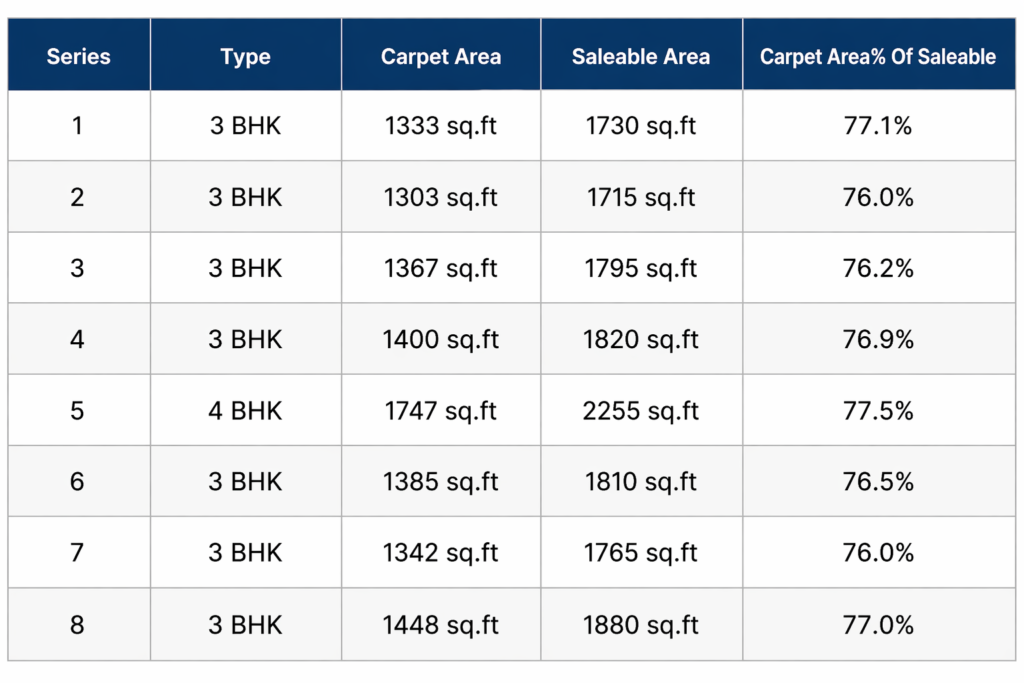
Udbhav Chinmaya’s carpet area consistently sits above 75% — firmly in the higher band of Mangaluru’s market average. To put that in real terms: on a ₹1.45* Crore Series 1 3 BHK Apartment, Udbhav Chinmaya gives you 1333 sq.ft of carpet area. But somewhere else in the City, that same budget would give you only 1125 sq.ft of carpet area. — that’s 208 sq.ft less (roughly the size of a full bedroom) at the same price point.
Udbhav Chinmaya gives you around 17% more living area than the national average buyer gets today at the same budget.
The one thing every buyer should do: Always ask for the exact carpet area of your preferred unit before booking. Since 2017, RERA mandates developers disclose this clearly in all agreements. At Udbhav Chinmaya, Our team shares the exact carpet area breakup for every unit during your site visit — no hidden loading surprises. Schedule a visit to get the complete floor plan with dimensions.
Engineering & Longevity
To ensure a building lasts long, buyers should think about it like a German car—people pay more for them because they are safer and better made.
A top-quality building gives you a sense of security and better chances of holding up against weather and other stresses. In coastal cities like Mangalore, one big problem is using saltwater sand. It’s cheaper but has salt that breaks down steel and concrete over time, possibly cutting the building’s life in half. You might even see white spots on walls within two years.
The "Wet Patch" Checklist: Mangaluru’s heavy monsoons are a real test
Before buying, check the following:
- Ceilings: Look for dark fungus or bubbling paint, which could be a sign of water damage from the unit above.
- Exterior Paint: Ensure the builder used high-grade weather-resistant coatings. Otherwise, the building will look old and lose value quickly.
- Basement Smell: A damp or musty basement could indicate poor drainage, which is a big red flag for the building’s health.
Legal Compliance: The Transparency of Mangalore
Mangalore is considered a more law-abiding place compared to bigger cities like Bangalore. This is because the level of development is smaller, making it easier for government officials to inspect and keep track of construction projects. On the other hand, in Bangalore, the amount of construction is so large that it’s nearly impossible for authorities to check every building regularly, which often results in issues like confusion and more corruption. In Mangalore, both the builders and the common people are more aware of and willing to follow rules regarding land use and building permits.
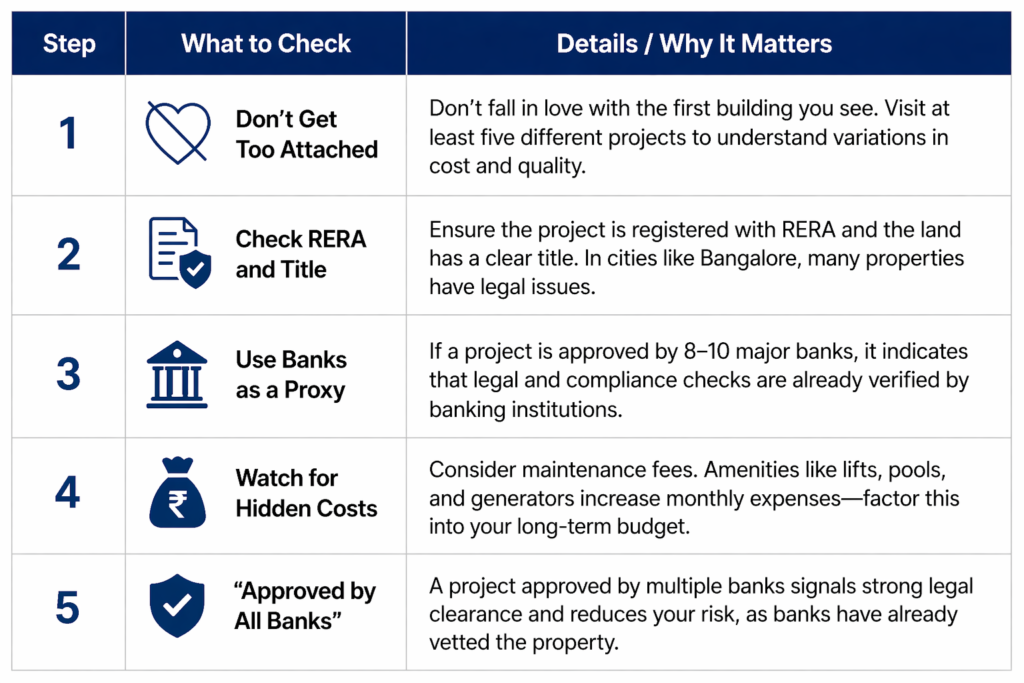
The Buyer’s Due Diligence Checklist
Buying a home is a big investment that can last a lifetime, yet many buyers look only for the cheapest option instead of the best quality.
Emerging Micro-Markets: Where to Put Your Money
Mangaluru is developing into two distinct areas:
The Prime Core (Kadri & Bejai): These are top-tier investments.
High rental demand from doctors and professionals means low vacancy rates. If you can afford the entry price, the long-term stability is unmatched.
The Growth Corridors (Derebail & Bondel): As the airport road expands and Mangaluru Smart City projects take shape, these areas are seeing big infrastructure upgrades.
They offer a good balance for young families who want modern amenities at a lower price.
The Smart City Factor: With waterfront promenades and upgraded drainage, property values in areas involved in Smart City projects are expected to rise by 15-20% in the next five years.
Conclusion: Quality Over Size
The best advice for any homebuyer is to focus on quality instead of size.
If a high-quality three-bedroom apartment is too expensive, it’s better to buy a high-quality two-bedroom from a reliable builder. For more information check out Udbhav chinmaya on 3 & 4 BHK residential apartments. A well-built home like udbhav chinmaya gives you peace of mind, cost-effective maintenance, and higher resale value.
Frequently Asked Questions
Yes — and here's why.
Mangalore provides something most cities don't: a high quality of life at reasonable prices. When compared to Bangalore, you can find a well-connected and spacious apartment for much less money — all while enjoying a coastal climate, a close-knit community, and much less traffic stress.
What makes Mangalore Apartment a smart buy right now:
- Property Prices Are Still Realistic — Kadri, Bejai, and Kodialbail are established localities with limited new land supply, meaning values only move upward
- Infrastructure is expanding — NH-66, New Mangalore Port, and Bajpe International Airport are all driving long-term appreciation
- NRI demand keeps the market stable — coastal Karnataka has one of India's highest NRI populations, creating consistent housing demand year-round
- RERA has made buying safer — always verify registration before booking. A RERA-approved project means your money and timeline are legally protected
- Rental yields are healthy — growing student and professional population means strong demand for quality 3 BHK rentals in prime areas with estimated yield ₹22,000 – ₹28,000. Read more about Mangalore's apartment rentals
The bottom line: Mangalore is one of Karnataka's most underrated real estate markets. The window of reasonable pricing won't stay open much longer — especially in prime central neighbourhoods where quality inventory is genuinely scarce.
Yes — and it's one of the most overlooked factors when comparing apartments. The taller a building is, the more shared infrastructure every resident has to pay for.
A 27-floor tower requires multiple high-speed lifts, wide fire escape staircases on each floor, large ground-floor lobbies to accommodate hundreds of residents, and long corridors that stretch across every floor. Every square foot of that infrastructure is shared and divided among all the units as part of the cost — and you end up paying for it whether you use it or not.
A small, low-rise building with just Ground + 5 floors and 40 units has a much smaller amount of shared infrastructure. Fewer floors mean fewer lifts, shorter corridors, smaller lobbies — and a much larger portion of your money goes toward your actual living space.
Most buyers look at price, location, and amenities when choosing a home. Few, however, ask the key question that really tells them how much usable space they're getting for their money. This is known as the carpet area percentage, and it differs greatly from one project to another, often based on a factor that most buyers never consider.
This is called the carpet area percentage, and it varies a lot from project to project.
On a national level, the average carpet area makes up just 60% of what you pay for — meaning 40% of every rupee goes toward shared spaces like lobbies, lift shafts, and corridors that you don’t own exclusively.
At Udbhav Chinmaya, the carpet area percentage is over 75% — confirmed across all 8 unit types and well above the national average.
Before comparing any two apartments, always ask the developer one straightforward question: “What is the carpet area percentage of this unit?”That single number tells you more about the value you're getting than the price per square foot ever will.
Not exactly — and that's actually good news for buyers.
Bangalore's real estate growth came with a price: ₹15,000–20,000 per sq.ft in prime areas with overcrowded infrastructure. Nobody who bought in Koramangala in 2005 predicted it would become unaffordable by 2020.
Mangalore is on a growth trajectory — but a more measured, liveable one.
The fundamentals driving that growth are real. Infrastructure investment through NH-66 and NH-75 expansion, a growing international airport, New Mangalore Port activity, ONGC and MRPL presence, Infosys offices, and one of Karnataka's strongest education and healthcare ecosystems. Property prices in prime areas like Kadri are currently ₹6,500–8,000 per sq.ft — roughly 40–50% lower than comparable Bangalore neighbourhoods.
The more accurate comparison is not "will it become Bangalore" but "will it follow Bangalore's early trajectory" — and the answer to that is increasingly yes. The same forces that drove Bangalore's early appreciation — infrastructure, employment, NRI demand, and limited prime land supply — are all present in Mangalore today.
The difference is you still have time to get in before that appreciation fully plays out.


